

A SYSTEM OF RECORD IS A DECISION, NOT A TOOL
Six months after the rollout, you are watching it happen again. Someone has pinged three people to find the status of one project. The real update is buried in an email thread you are not on. The platform you bought to end exactly this is open in a tab, mostly empty, while the work has quietly routed back to the places it always lived, the inboxes and the side channels and the head of the one person who still remembers how it goes.
You did not buy the wrong software. You ran the rollout as though the software were the system, and it is not. A system of record is an agreement about how work moves. The place you put the work is the smallest part of it, and it is the only part that comes in a box.
That gap is where the money goes. A tool you bought and did not adopt is the most expensive software there is, because you pay for it twice, once at purchase and again every month the work keeps routing around it. The reason it did not take is almost never the tool. The rollout got run as a configuration project, when the real work was a set of decisions the software was never going to make for you.
The decisions the software will not make for you
Who owns a piece of work, the one name accountable for it rather than everyone with a hand in it, so that when it stalls there is a person to go to instead of a committee. What “done” means, and what “waiting on someone else” means, defined in plain terms so a status carries information instead of a mood. Which kinds of work get a standard shape, so the tenth event starts from the last one rather than from nothing. How often people are expected to be in the system, so it stays current enough to trust. And who owns the system itself, with a backup and a path for when it drifts, so governance does not fall by default to whoever complains the loudest.
None of that ships with the license. Each one is a call a leader has to make and then stand behind.
What the Sprint actually did
The Studio Sprint is a build week, though the building was the smaller half of it. At the established membership association where we ran one, the team already understood their jobs; a staff survey confirmed that effort was never the issue, and the work was breaking in the seams between people. The week went to closing those seams.
Their real work moved into one system, the actual events, sponsorships, and cross-functional initiatives they were already running, never sample data. We rebuilt it by function in live working sessions, so the people who run events shaped the events workflow and the people who run marketing shaped the handoffs into it. Every task got a single owner. Every status got a written definition, including what “waiting on someone else” is allowed to mean. The work that repeats got standard templates, so the tenth event starts from the last one instead of from scratch. And the rules that keep it honest, who owns the system, who backs that person up, and how a stuck item gets escalated, went into a handbook the team could hold each other to.
The decisions were the hard half, and they got made in the room with the people who would live by them. Leadership sat in the working sessions, not only the kickoff, because a norm only carries weight when the person who can enforce it is the one who set it. A system the staff adopt and leadership works around is just one more tab. A system leadership visibly works inside becomes the way things are done.
Why it saved money
Most organizations have already paid this bill at least once, the platform bought with real budget and real hope that now sits unused. The Sprint keeps the spend from draining into shelfware, because adoption gets built during the week, on live work, with the person who can make the decisions hold, rather than left to chance afterward. What that protects is the whole investment at once, the license and the staff hours and the leadership attention, all of it wasted the moment using the system becomes optional.
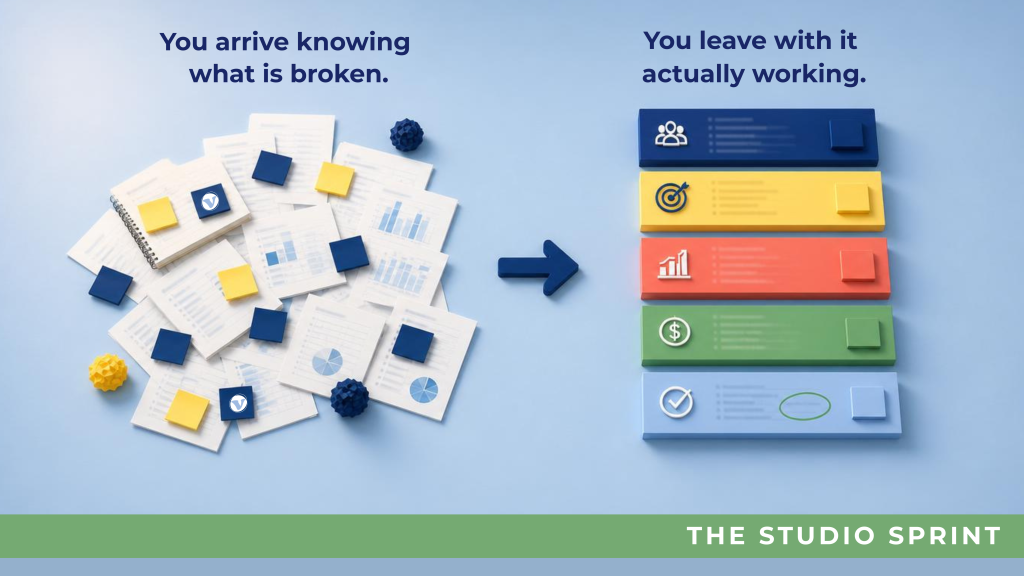
You can buy the tool in an afternoon. The decisions underneath it are the system, and they are the part worth slowing down for.
Make the decisions first. Then the tool has something to hold. That is the work we do at Vivia Studios.
Erin Peshoff is the Chief Curator of Vivia Studios. She has spent thirty years inside nonprofit operations, helped raise over $100 million for institutional missions, and built Vivia around the operating discipline most strategic engagements skip.