

Before you Write a Word
This morning I sat in a room full of nonprofit leaders at the Community Foundation for Loudoun and Fauquier Counties, working through what it actually takes to produce an annual report that works. Robin McGlothin, Amy Stirnweis, and Carrie Idol-Richards from the Good Plan Group walked us through the full arc: purpose, data, stories, resources, distribution. It was practical and generous and exactly the kind of session that sends you home with a clearer head.
It also confirmed something I have been thinking about for a while: every year, sometime between July and September, a fundraiser sits down to write the annual report with a specific charge to put the year on the page, in numbers and stories, for the people who made it possible.
And every year, in organizations where the infrastructure is not there, the same thing happens.
- Someone pulls up last year’s report for reference and realizes the data does not match what is in the CRM.
- Someone asks for the impact numbers and gets three different answers depending on who you ask.
- Someone goes looking for the donor quotes collected at the gala and finds out they live in a personal email inbox that belongs to a staff member who left in April.
I can promise you that the annual report does not create these problems. It reveals them.
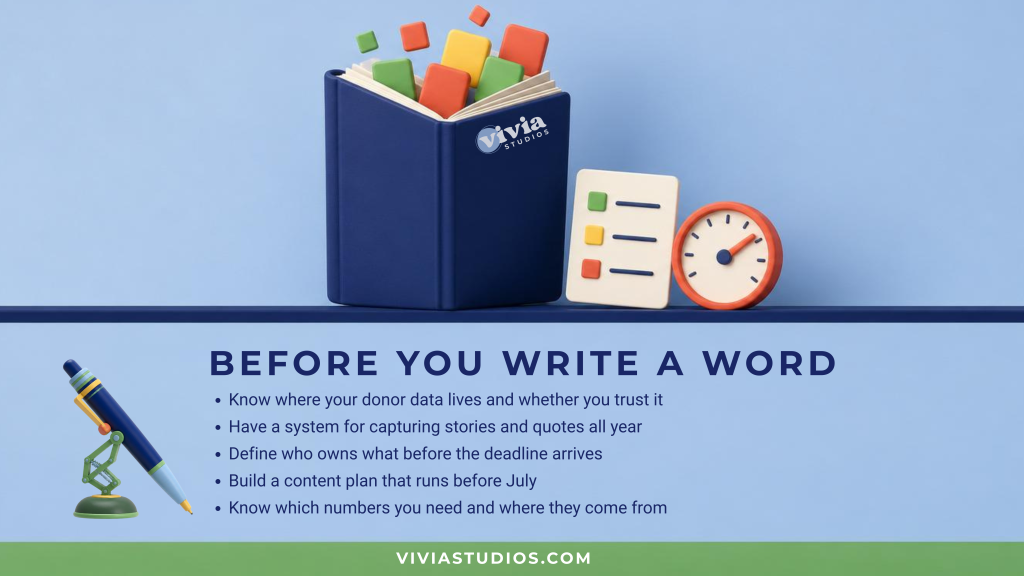
What makes a report hard to produce is almost never the writing. It is the things that had to be working before anyone opened a blank document.
- The data had to be clean and in one place.
- The stories had to be captured somewhere other than someone’s memory.
- The ownership of who pulls what had to be clear before the deadline arrived.
- The content had to be planned far enough in advance that the pieces exist when you need them.
- The processes for how impact gets recorded had to be running all year
A fundraiser who can produce a clean annual report without a scramble is not a better writer. They are working inside a better operation.
Here is what we see in organizations where the report comes together without crisis.
- The CRM has been maintained well enough that the donor data is trustworthy.
- The content plan captured stories and quotes throughout the year, not just at the end.
- The SOPs defined how impact gets recorded so the numbers are consistent.
- Ownership was clear on who pulls financials, who writes program outcomes, who manages the design process.
- Reporting gave leadership a view of the year that did not require rebuilding everything from scratch in July.
None of that is glamorous and it doesn’t show up in the report itself, but all of it is what makes the report possible.
If your annual report process feels like an emergency every year, the emergency started in January. The fix is not a better template or a tighter deadline. It is the infrastructure underneath, running quietly all year, so that when July arrives the work is mostly already done.
We build that infrastructure. If you want to know where yours has gaps, that is exactly the kind of conversation we have.
Erin Peshoff is the Founder of Vivia Studios. She has spent thirty years inside nonprofit operations, helped raise over $100 million for institutional missions, and built Vivia around the operating discipline most strategic engagements skip.