WHAT YOU ARE BUYING WHEN YOU DOCUMENT A PROCESS
Somewhere in most growing organizations there is a binder, or a folder full of documents, that someone paid good money to produce. It captured how the work gets done, it was thorough, and almost no one has opened it since the week it was delivered.
That is the standard outcome of a process documentation project, and it is worth being honest about why. The documents were written to be complete rather than to be used. Those are different goals, and only one of them changes how the organization actually runs.
When the instinct is completeness, you get procedures that try to capture every contingency, in a generic template voice, at a length no one will follow under the pressure of an actual Tuesday. The binder is technically correct and practically dead. The knowledge it was supposed to move out of people’s heads is still in their heads, because the written version is harder to use than just asking the person who knows.
So the real money question is what you are actually buying when you document a process.
The goal was never the documents
A scaling organization came to us needing roughly fifty procedures written down. The knowledge of how the work got done lived with a handful of people, every handoff routed back through them, and onboarding a new hire took months because there was no usable record of anything.
The deliverable they needed was not fifty documents. It was fifty documents people would actually open and follow. That is an editorial problem before it is a documentation problem, and it is the part that gets skipped.
What the Signature did
The Studio Signature is the long editorial engagement, and it started where the writing did not. Before a single procedure was drafted, the standards got locked: what a good procedure looks like here, how long, in what voice, at what level of detail. Editing what already existed into a clear standard came before building anything new. Decide what good looks like, then write to it.
Then the genuinely hard part, which is that a good procedure has to serve two readers who want opposite things. The executive wants the short version, the shape of the process and the decision points, and nothing past that. The operator wants every step, because they are the one who has to run it without guessing. A document that satisfies only one of them fails the other. The editorial work is writing the one document both can use, the executive reading the top and the operator reading all the way down, in a voice the team recognizes as their own.
Fifty procedures, written that way, so they would be the thing someone reaches for instead of interrupting the one person who knew.
Why it saved money
Documentation that goes unused is a cost paid twice. You pay to produce it, and you keep paying the original bill, the slow onboarding and the stalled handoffs and the expert who still cannot step away, because the knowledge never actually transferred. The binder on the shelf did not buy down a single one of those costs.
The editorial work is what separates those two outcomes. It is the reason the spend turns into procedures that get used, which is the only version of documentation that returns anything. A process written to be followed offloads the knowledge it describes. A process written to be complete just describes it, expensively.
The goal was never fifty documents. It was the knowledge those documents were supposed to carry, finally living somewhere other than one person’s head. Write them to be used. That is the whole difference.
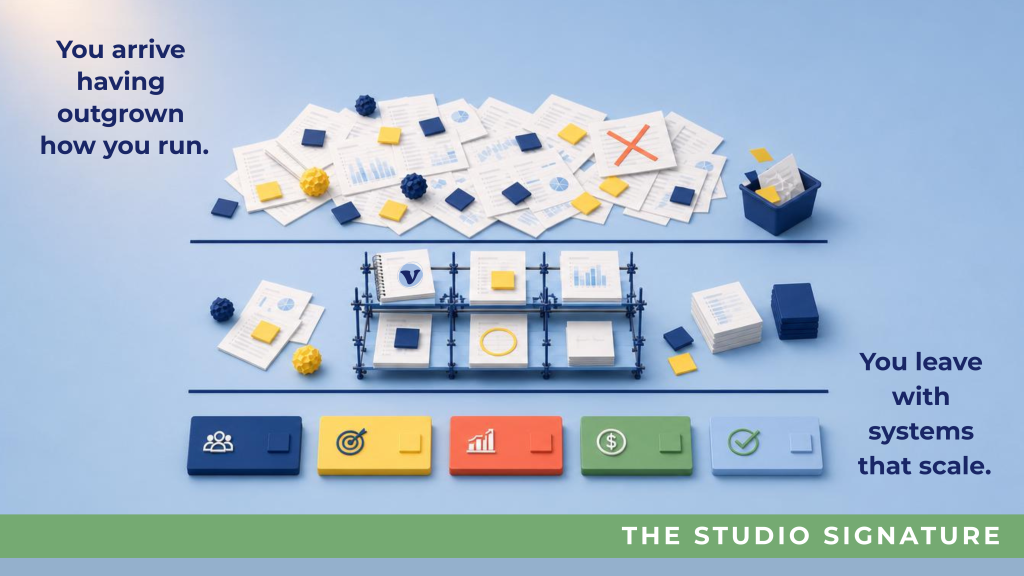
That is the work we do at Vivia Studios.
Erin Peshoff is the Chief Curator of Vivia Studios. She has spent thirty years inside nonprofit operations, helped raise over $100 million for institutional missions, and built Vivia around the operating discipline most strategic engagements skip.